
Monkeys Understand Shapes in Almost the Same Way as Humans Beings
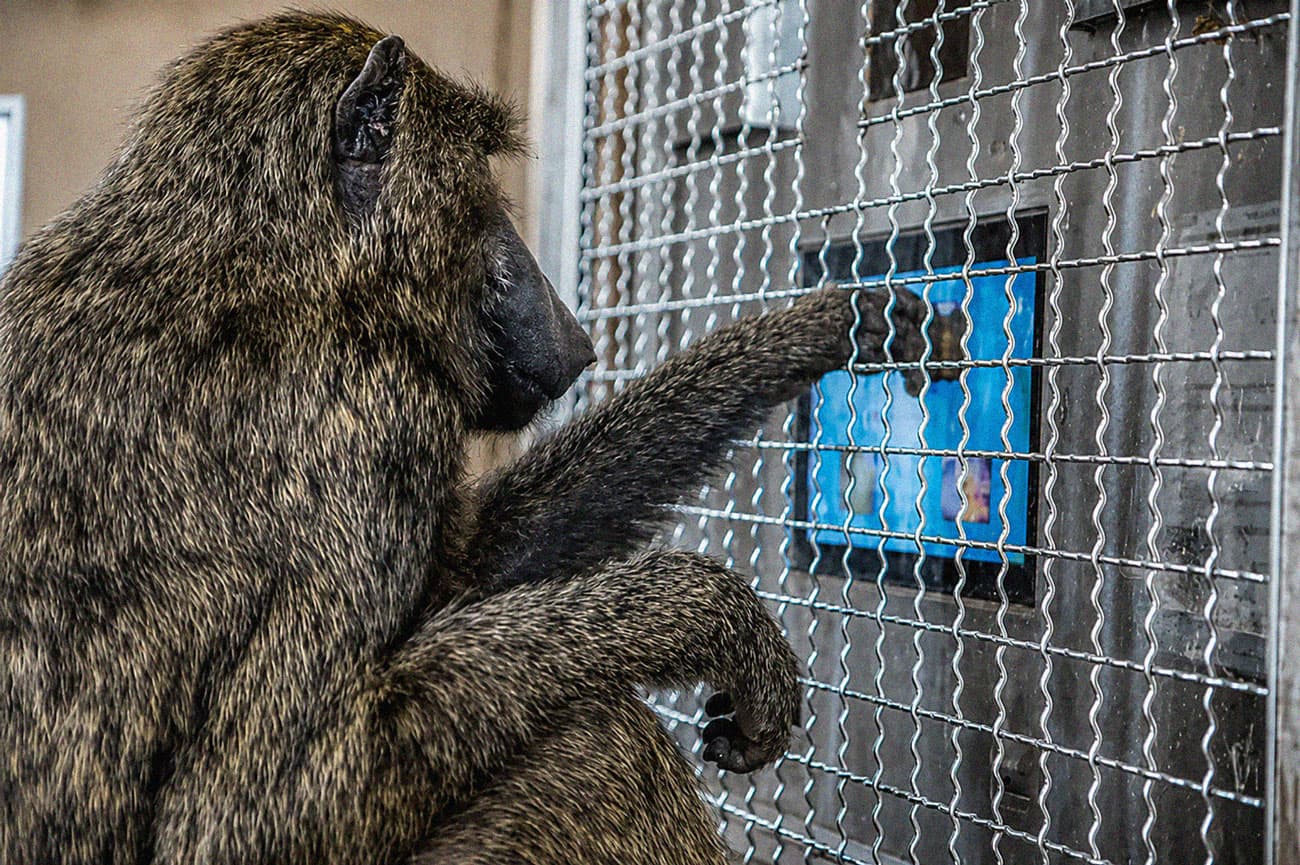
Our geometric intuition, long considered something that sets us apart, seems to be shared with other primates. In a quiet corner of the Seneca Park Zoo in New York, a baboon named Kalamata is redefining what it means to be a genius. For two to three hours at a time, the hardworking primate methodically taps a touchscreen, matching rotated geometric shapes with an accuracy that rivals that of human preschoolers. He isn't alone. Researchers recently discovered that four rhesus macaques and four olive baboons—just like young children and adults—think about geometry in fundamentally the same way, challenging decades of assumptions about what makes our brains unique. "What surprised us wasn't just that monkeys could do the task," said Jessica Cantlon, a cognitive neuroscientist at Carnegie Mellon University and senior author of the study. "It was that monkeys, children and adults seemed to think about geometric relationships in fundamentally the same way. That suggests these intuitions are part of the basic architecture of the primate mind."
The 2026 Study That Changed Everything
At the heart of this paradigm shift is a groundbreaking investigation published in the Proceedings of the National Academy of Sciences (PNAS). The study, "Continuity in Geometric Intuition Between Humans and Monkeys", provides compelling evidence that the origin of geometric intuition is shared among primates. For decades, the prevailing theory held that humans' unique geometric abilities were part of a categorical divide in symbolic cognition. Jialin Li, a Ph.D. student at Carnegie Mellon and lead author of the study, stated, "Our hypothesis was that humans are not that unique" in possessing this mathematical understanding.
The research team designed a cleverly simple "match-to-sample" task to test this hypothesis. Participants—including the monkeys, American preschoolers (ages 3-6), and adult humans with different education levels—were shown a shape on a screen and asked to pick that same shape out of a group of others, even when it was rotated or resized. The critical test involved shapes with no distinct color, size, or form cues, meaning the participants had to rely solely on abstract geometric similarity to make a match. "You'd get tripped up, too," Cantlon warned, noting that the task is deceptively difficult.
The Human Element: Accounting for Education and Culture
To untangle what is innate from what is learned, the researchers performed the same experiment with 21 American adults, 58 American preschoolers, and crucially, 79 adults from Bolivia's Indigenous Tsimane' people. The Tsimane' are a farmer-forager group that does not undergo the same sort of formal schooling found in the United States. "That allowed us to sort of tease apart age and cultural experience," Cantlon explained. "Because sometimes when you're trying to study something in children, it can be difficult to untangle whether their ability is developmental or something learned from education or experience."
The findings were resounding. The analysis showed that humans and monkeys both used a combination of high-level perceptual representations and abstract symbolic representations to solve the task. The study concluded that the "stronger reliance on symbolic features" observed in educated adults is likely learned and strengthened through formal education, rather than being an inherent, uniquely human quality.
What Monkeys See That We Don't
The research revealed that participants across all groups were processing shapes based on abstract qualities like symmetry, parallel lines, and right angles. The monkeys, like the children and adults, were making connections between shapes and their angles, ratios, and patterns. This challenges the long-held notion that only humans rely on discrete, symbolic features to encode geometric shapes while other primates depend only on continuous perceptual features. The study emphasizes that what appears to be human-specific symbolic representation may largely emerge from "rotation-invariant encoding"—the ability to recognize a shape no matter how it's turned—a skill shared across the primate order.
Primate Portal: The Lab Without Walls
These insights were gathered thanks to the "Primate Portal," an ongoing project at the Seneca Park Zoo where primates freely interact with a touchscreen offering customizable cognitive tasks. The enclosure allows the animals to participate at will, with one particularly dedicated subject making a lasting impression on the researchers. "One of the baboons, named Kalamata, was the hardest working monkey that I've ever seen," Li told reporters. "He would come up to the screen and wait for me to turn the computer on, and then he'd just sit there for two to three hours just doing all kinds of mathematical tasks."
What About Africa? (A Region of Evolutionary Significance)
While this study was conducted in the U.S. with captive primates, researchers have long used field studies in Africa to understand the roots of animal cognition. For instance, work at Lake Nabugabo, Uganda, has tested wild vervet monkeys on reversal learning tasks, demonstrating that cognitive paradigms can be successfully adapted for field settings. Scientists have also examined the cranial and phylogeographic variation of large-bodied primates like baboons across Africa to understand the evolutionary pressures on morphology and cognition.
Conclusion: Building Education on Ancient Foundations
This new understanding has profound implications for education. "Geometric intuition is something humans eventually turn into mathematics and science," Cantlon noted. "So if we want to understand how children learn geometry, we need to understand what they bring to the table before formal instruction begins." The research suggests that instead of treating geometry as something that must be taught from scratch, educators can build on deep, evolutionarily ancient intuitions about shape and space. "The results suggest that abstract thought is not an all-or-none ability that suddenly appeared in humans," Cantlon added. "Some of the cognitive foundations of mathematical reasoning appear to be shared across primates, with human education and culture building on these ancient biological capacities."


Comments (0)