
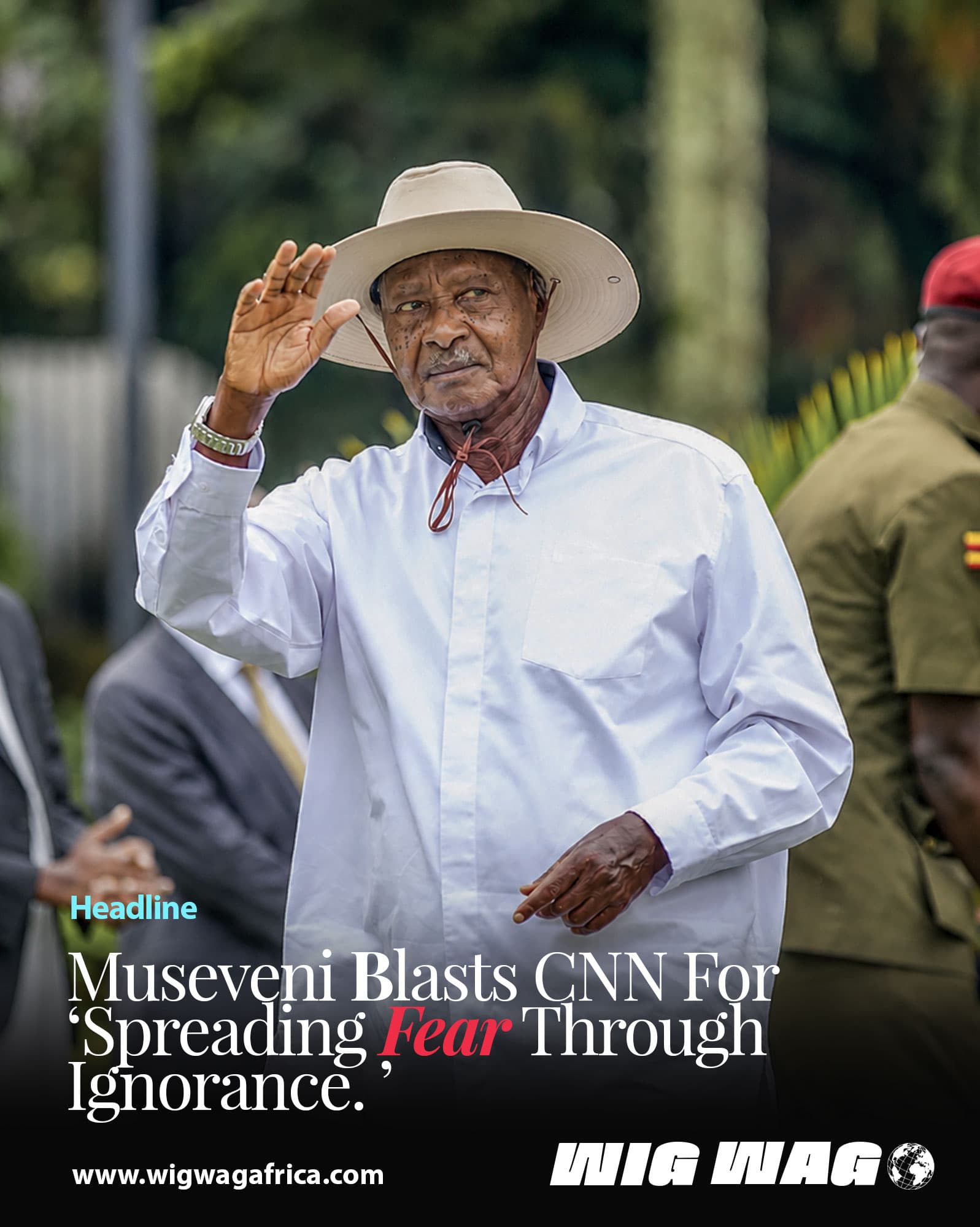
Museveni Blasts CNN For ‘Spreading Fear Through Ignorance,’ Says Ebola Panic Threatens Uganda’s Tourism Boom
By WigWag Africa Editorial Desk
May 21, 2026
President Yoweri Museveni sharply criticized CNN on Thursday, accusing the American news network of “spreading fear through ignorance” in its coverage of the Ebola outbreak in East Africa, as the Ugandan leader dismissed concerns over the virus and instead emphasized the country’s preparedness, economic resilience, and rapidly growing tourism industry.
The remarks came during the opening ceremony of the 10th Pearl of Africa Tourism Expo (POATE 2026) at the Speke Resort Convention Centre in Munyonyo, where tourism officials, investors, creatives, and international delegates gathered under the theme “Wanderlust – It’s Your Time to Thrive.” But beyond tourism promotion, the event quickly evolved into a broader discussion about global perception, media influence, and how international narratives can directly impact emerging economies.
Museveni said he had been “watching CNN spreading fear through ignorance,” arguing that Ebola is significantly easier to control than COVID-19 because it spreads through direct physical contact rather than airborne transmission. According to the president, the outbreak remains largely concentrated in the Democratic Republic of Congo, with Uganda only registering two imported cases so far — one of which resulted in a fatality — and no major local transmission patterns currently identified.
The president further argued that Uganda had already demonstrated its ability to manage major public health crises during the COVID-19 pandemic and would replicate that same response structure if necessary. Museveni claimed Uganda was among the most successful countries globally during COVID management, emphasizing surveillance systems, border monitoring, and coordinated public health enforcement.
“I was watching CNN spreading fear through ignorance,” Museveni told tourism stakeholders. “Ebola is much easier to control than Corona. Corona was spreading through breathing. Ebola spreads through intimate contact. Therefore, Ebola is nothing compared to Corona. Please educate CNN.”
The comments reflect a deeper tension increasingly visible across Africa: the collision between international media narratives and economic positioning. For governments heavily investing in tourism, infrastructure, and global investor confidence, perception itself has become strategic infrastructure.
Uganda’s tourism sector has become one of the country’s fastest-growing economic pillars. Tourism earnings reportedly hit a record $1.7 billion in 2025, up from approximately $1.28 billion the previous year, while international visitor arrivals increased from 1.3 million to roughly 1.65 million people. The government has positioned tourism as a central driver of its long-term upper-middle-income ambitions, with broader targets extending toward $50 billion in tourism-related economic value by 2040.
That growth makes the timing of the Ebola outbreak particularly sensitive.
Since May 15, Uganda’s Ministry of Health has remained on heightened alert after confirming an imported case of the Bundibugyo Ebola strain involving a 59-year-old Congolese national who later died at a Kampala hospital. A second imported case has since been identified. While authorities insist containment systems remain active, regional and international health organizations continue expressing concern over cross-border transmission risks linked to the ongoing outbreak in eastern DRC.
The World Health Organization recently declared the situation a Public Health Emergency of International Concern (PHEIC), citing nearly 600 suspected cases and over 130 suspected deaths across the border in Congo. Health officials also noted that the Bundibugyo strain currently lacks approved vaccines or therapeutics, increasing concerns around containment and emergency response capabilities.
At the same time, escalating insecurity and displacement in eastern Congo have complicated regional health management. More than 100,000 people are believed to have been displaced in affected regions, increasing the likelihood of cross-border movement and making disease surveillance significantly more difficult.
Yet Museveni’s position appears focused less on denying the existence of risk and more on resisting what he views as economically damaging global panic narratives.
From a strategic perspective, Uganda’s response reflects a broader reality emerging across developing economies: information itself now directly affects economic systems. A single headline, viral report, or international advisory can influence airline bookings, investor confidence, tourism revenues, conference attendance, and even currency sentiment within days.
This is particularly relevant in the modern algorithmic media environment, where fear-driven narratives often spread faster than nuanced public-health communication.
For Uganda, the stakes are enormous. Tourism supports more than 165,000 direct jobs and contributes nearly 13% of the country’s GDP. Beyond wildlife and safari tourism, Uganda has increasingly positioned itself as a regional destination for conferences, entertainment, culture, sports tourism, and investment forums. POATE itself represents part of that long-term branding strategy — an attempt to elevate the “Pearl of Africa” identity into a globally recognized tourism and investment brand.
Museveni also used the platform to criticize Uganda’s current visa structure, arguing that restrictive tourist visa timelines reduce long-term visitor spending. The president questioned why tourists entering Uganda are often granted short stays while Western countries provide longer-duration visas to international visitors.
“If you go to America they give you a visa for three years, but here you give only three months. Leave them; it is their money,” Museveni said, while proposing longer-term tourist visa options aimed at encouraging extended stays and larger tourism expenditures.
But beneath the political rhetoric lies a larger global issue that extends far beyond Uganda or Ebola alone: the growing power of narrative economics.
In today’s digital world, countries are no longer competing only through infrastructure, natural resources, or policy. They are also competing through perception management, media trust, and information control. Tourism economies are especially vulnerable because tourism is fundamentally psychological. Travelers do not simply purchase flights or hotels — they purchase perceived safety, aspiration, emotion, and confidence.
That reality becomes even more intense in the social-media era, where global news cycles amplify fear faster than governments can respond.
For Africa, this creates a difficult balancing act. Governments must simultaneously maintain transparency around health risks while preventing exaggerated narratives from collapsing economic momentum. Too little communication creates distrust. Too much panic damages entire industries.
The Museveni-CNN clash therefore represents more than a disagreement over Ebola coverage. It highlights a deeper global shift where information ecosystems increasingly shape economic outcomes in real time.
At the center of this tension is trust.
As global audiences consume information through fragmented digital systems driven by algorithms, outrage, and virality, credibility itself is becoming strategic infrastructure. Countries, businesses, media platforms, and institutions are all competing within what many analysts now describe as a “trust economy” — an environment where public confidence directly affects economic performance.
For African economies attempting to scale tourism, investment, and digital influence simultaneously, controlling the balance between transparency and perception may become one of the defining strategic challenges of the next decade.
Uganda’s government appears determined to ensure that fear does not become more economically destructive than the virus itself.


Comments (0)