
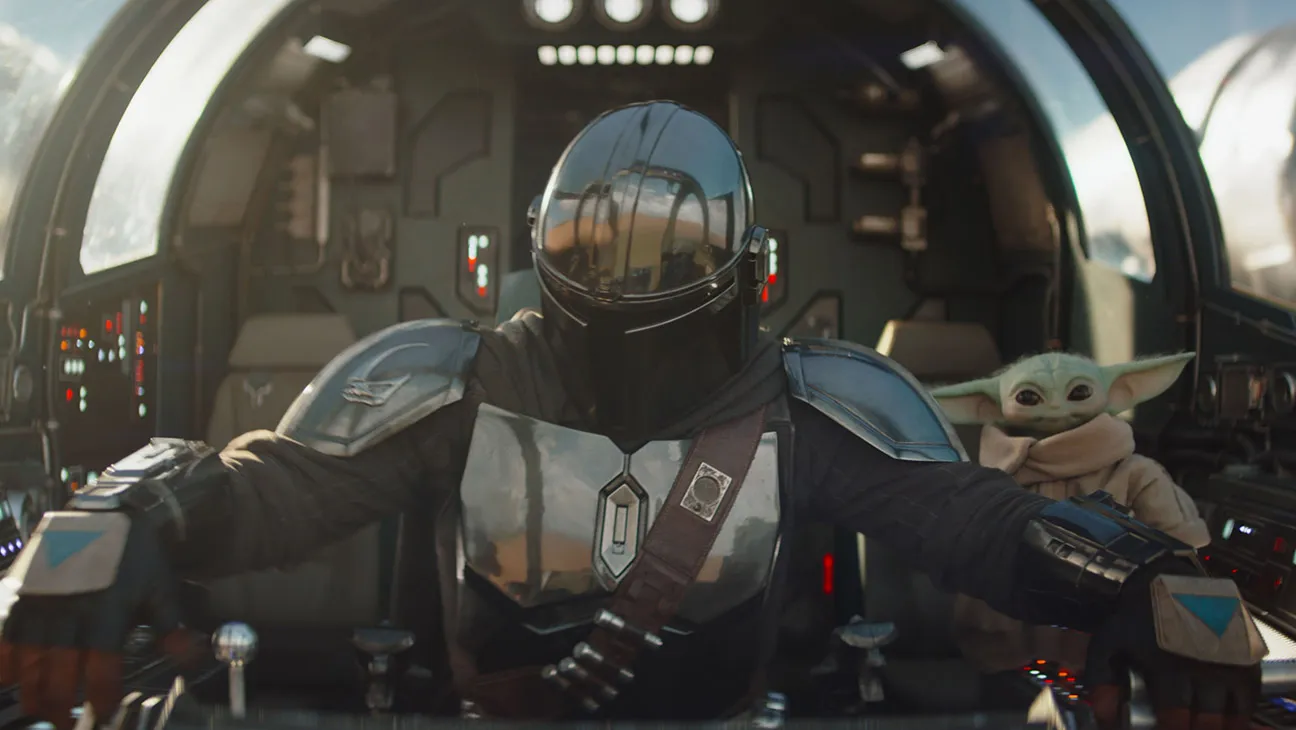
Star Wars Returns: Baby Yoda Saves the Box Office
After seven long years, the Force has finally returned to the big screen. But it took a tiny, green, 50-year-old toddler to remind audiences why they fell in love with a galaxy far, far away.
For the first time since 2019’s divisive Star Wars: The Rise of Skywalker, a new chapter in the Lucasfilm saga has landed in theaters. And while the opening weekend for The Mandalorian and Grogu was not without its nail-biting moments, the little guy with the big eyes has delivered a major victory for Disney — and perhaps an even bigger victory for theatrical cinema itself.
The Jon Favreau-directed feature, adapting the Disney+ series that helped launch the streaming era, opened to an estimated $100 million over the four-day Memorial Day holiday weekend in North America. That places it comfortably in the middle tier of Disney’s Star Wars films — far below The Force Awakens’ record-shattering $248 million debut in 2015, but well ahead of 2018’s troubled Solo: A Star Wars Story, which limped to $103 million over the same holiday frame before becoming the franchise’s first major financial disappointment.
But the real story is not simply the final number. It is the emotional recovery of a franchise that many believed had lost its cinematic identity.
A Bumpy Start: When Mando Nearly Missed the Mark
Heading into the weekend, industry tracking projected The Mandalorian and Grogu would debut around $82 million for the four days. Some exhibitors predicted as high as $95 million; others feared the film could collapse closer to $70 million. By Friday morning, after earning a worrying $33 million from 4,300 theaters — below the $35.4 million opening day of Solo — Disney and Lucasfilm executives reportedly grew anxious.
Had Jon Favreau’s beloved bounty hunter failed to translate to cinemas? Had the seven-year theatrical gap weakened audience loyalty? Was Star Wars, once Hollywood’s most reliable blockbuster machine, finally experiencing irreversible franchise fatigue?
Then Saturday arrived.
Families showed up in force. Walk-up business surged dramatically. By Sunday morning, Disney insiders were projecting a four-day total between $92 million and $96 million, while rival studios believed the film would cross the symbolic $100 million threshold.
By Monday afternoon, the studio settled on an estimated $100 million domestic opening, alongside an additional $63 million internationally for a worldwide debut of $165 million. That global figure alone nearly matched the entire four-day worldwide launch of Solo — despite Solo reportedly costing more than $275 million before marketing expenses. The Mandalorian and Grogu, by comparison, carried a much leaner production budget of roughly $165 million.
In an industry increasingly obsessed with efficiency, that difference matters enormously.
The Grogu Effect: Why Baby Yoda Still Works
What ultimately changed the momentum? One word: Grogu.
The character affectionately known worldwide as Baby Yoda made his transition from streaming icon to theatrical phenomenon with remarkable ease, and younger audiences responded immediately. The film earned one of the strongest audience reactions in modern Star Wars history, including an 89 percent audience score on Rotten Tomatoes and excellent PostTrak exit scores. Children under 13 reportedly awarded the film perfect ratings, while parents followed closely behind.
That emotional connection may prove more valuable than any opening-weekend statistic.
In the post-pandemic theatrical era, giant front-loaded openings have become increasingly rare. Instead, films capable of generating emotional attachment and repeat viewings tend to dominate over time. Disney believes The Mandalorian and Grogu could follow the same long-legged trajectory recently enjoyed by breakout crowd-pleasers like Project Hail Mary and The Devil Wears Prada 2.
Premium formats also played a massive role in the film’s performance. IMAX, 4DX, and other premium large-format screenings accounted for more than half of global ticket sales, with IMAX alone generating roughly $24.4 million during the holiday frame — one of the strongest Memorial Day performances in the company’s history.
The message from audiences appears increasingly clear: if cinemas are going to survive the streaming era, they must offer experiences that feel emotionally communal and visually irreplaceable.
The Other Surprise: Horror Keeps Winning
While Star Wars dominated headlines, the weekend’s most astonishing financial story came from a completely different corner of Hollywood.
Obsession, directed by YouTube creator Curry Barker and released through Focus Features, posted a stunning 39 percent increase in its second weekend — an almost unheard-of achievement for modern horror films, which traditionally collapse after opening weekend.
Produced for less than $1 million, the film earned an estimated $30.4 million over the four-day holiday period, pushing its domestic total beyond $60 million in just eleven days. The return on investment is so extreme that studio executives are reportedly scrambling to replicate the formula.
The success of Obsession reinforces one of Hollywood’s oldest truths: massive budgets are not always required to generate massive cultural impact. Emotional intensity, audience curiosity, and social conversation can still outperform expensive spectacle.
For African filmmakers and emerging studios, that lesson may be even more important than Disney’s victory.
The Rest of the Weekend: Michael, Prada, and Family Hits
Elsewhere at the global box office, Lionsgate’s Michael continued its remarkable run, surpassing $300 million domestically while pushing its worldwide total beyond $700 million.
Meanwhile, The Devil Wears Prada 2 remained one of the year’s most consistent performers, crossing $600 million globally while continuing to demonstrate the commercial power of nostalgia executed correctly.
Amazon MGM Studios’ family hit The Sheep Detectives also maintained strong momentum, adding another $12.8 million in its third weekend and pushing its domestic total toward $75 million.
Collectively, the weekend revealed something larger happening within Hollywood: audiences are not abandoning theaters entirely. They are becoming far more selective about what deserves the theatrical experience.
What This Means Beyond Hollywood
The story of The Mandalorian and Grogu carries lessons far beyond Disney and Lucasfilm.
For studios globally — including Africa’s emerging film industries — the film demonstrates that franchise fatigue is real, but emotional storytelling still cuts through audience exhaustion. Solo failed because it felt mechanically manufactured. The Mandalorian and Grogu succeeded because audiences genuinely cared about its characters.
Grogu transcended lore. He became emotional infrastructure.
That distinction matters.
In an entertainment economy increasingly dominated by algorithms, cinematic universes, and intellectual property expansion, audiences still reward stories that create emotional resonance rather than simply extending corporate franchises.
That reality is particularly important for African storytellers, where emotional authenticity has always been one of the continent’s strongest creative advantages. The best Ugandan dramas, Nigerian series, and South African productions succeed not because of billion-dollar budgets, but because they understand emotional immediacy, family tension, humor, struggle, and human connection.
The future of entertainment may belong less to whoever owns the largest franchise — and more to whoever understands audience emotion most deeply.
The Bigger Picture: Hollywood’s Trust Economy
There is also a deeper industrial signal beneath the box office numbers.
For years, Hollywood attempted to scale content endlessly through streaming expansion. Quantity became strategy. But audiences are increasingly rejecting content overload in favor of cultural moments that feel meaningful, communal, and emotionally trustworthy.
In that environment, franchises are no longer sustained purely by nostalgia or spectacle. They survive through audience trust.
The Mandalorian succeeded on Disney+ because it restored something many viewers felt Star Wars had lost: simplicity, emotional clarity, adventure, and wonder. The theatrical film appears to have benefited directly from that accumulated goodwill.
That dynamic increasingly mirrors the broader digital economy itself. In an era of infinite content, trust becomes infrastructure.
The Memorial Day weekend box office painted a striking picture of Hollywood’s shifting economics. The Mandalorian and Grogu led the frame with a strong $100 million four-day domestic opening and $165 million globally, matching its reported production budget in just a single weekend. Meanwhile, the breakout horror sensation Obsession continued its astonishing run, earning $30.4 million over the holiday frame and pushing its domestic total to $60 million — despite costing less than $1 million to produce. Elsewhere, Lionsgate’s Michael crossed the $300 million domestic milestone while surging beyond $700 million worldwide, further cementing its status as one of the year’s biggest global hits. The Devil Wears Prada 2 also maintained impressive momentum, clearing $200 million domestically and approximately $600 million globally, proving that nostalgia-driven franchises can still dominate when paired with strong audience reception.
All figures are estimates as of May 26, 2026.
The Force, it seems, is finally back in balance.
And it took a tiny green creature carrying a frog-like snack to remind Hollywood that audiences still crave wonder — as long as it feels real.


Comments (0)