
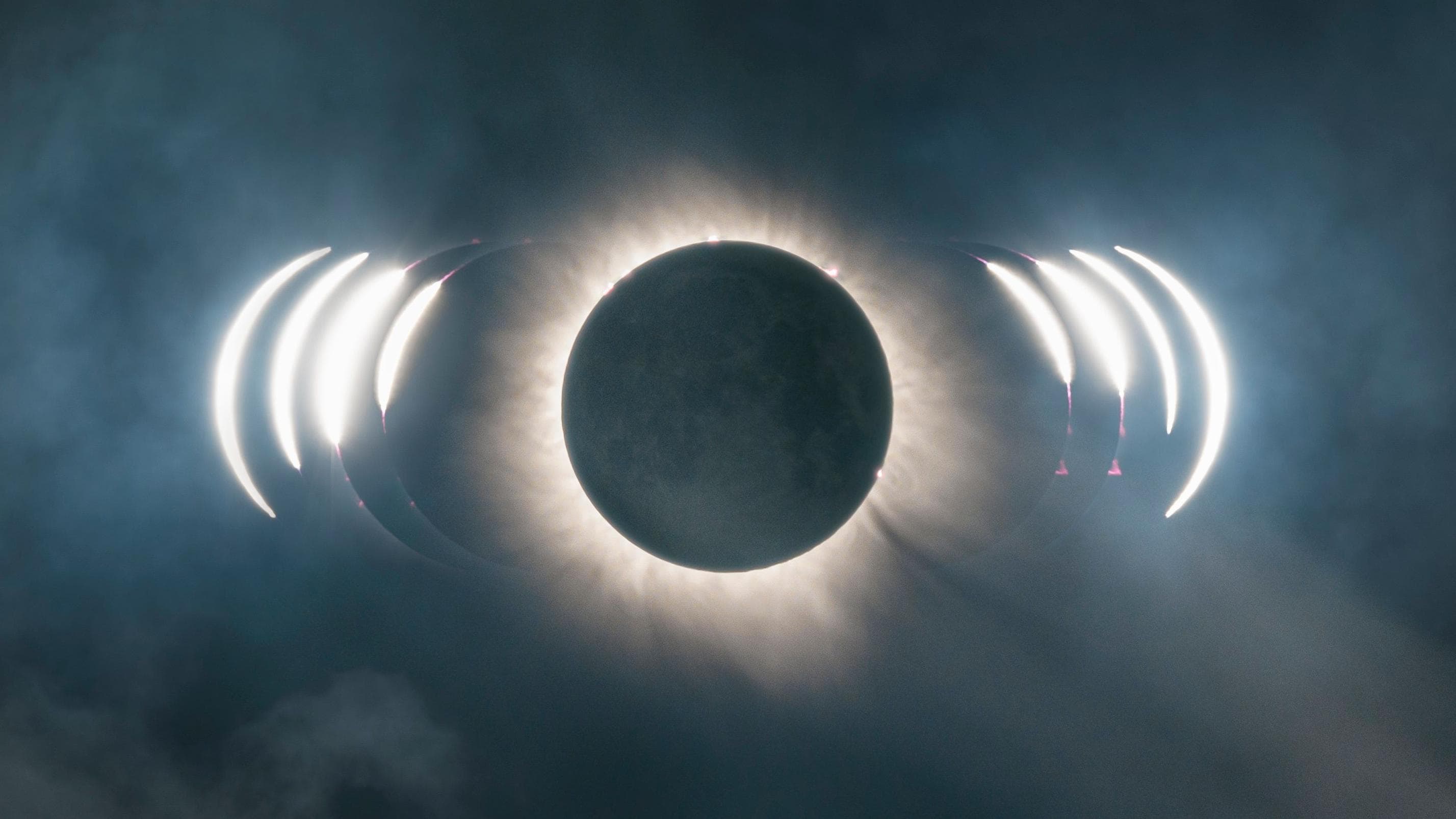
When the Sun Goes Silent: Africa’s View of the August 12 Total Solar Eclipse
On Wednesday, August 12, 2026, millions of people will stop what they're doing and look toward the sky as one of nature's most extraordinary spectacles unfolds. The Moon will pass directly between Earth and the Sun, casting a narrow shadow across parts of the Northern Hemisphere and creating a total solar eclipse over Greenland, Iceland, northern Spain, and a small corner of Portugal.
For just over 2 minutes, daylight will vanish. Stars will emerge in the middle of the afternoon, birds may fall silent, temperatures can briefly drop, and the Sun's outer atmosphere—the ethereal corona—will become visible to the naked eye. It is an experience that many eclipse chasers describe as emotional, unforgettable, and almost spiritual.
Will Africa See the Eclipse?
The answer is yes—but not all of Africa.
Unlike Europe, where a handful of countries will witness totality, northwestern Africa will experience a partial solar eclipse during sunset. Countries including Morocco, Western Sahara, Mauritania, Algeria, Tunisia, Libya, Cape Verde, Senegal, Gambia, Guinea-Bissau, Guinea, Sierra Leone, Liberia, Côte d'Ivoire, Ghana, Burkina Faso, and parts of Mali are expected to witness at least part of the event.
However, much of East Africa, Central Africa, and Southern Africa—including Uganda, Kenya, Tanzania, Rwanda, Burundi, South Sudan, Ethiopia, Zambia, Zimbabwe, Botswana, Namibia, and South Africa—will not see the eclipse at all because the Moon's shadow never reaches that part of the continent. For example, Kampala, Uganda, will not experience any phase of the eclipse.
What Time Will It Be Visible in Africa?
The eclipse reaches Africa during the late afternoon and evening, with many locations seeing the Sun already low on the western horizon.
Approximate local viewing times include:
• Morocco: around 6:30–8:30 PM • Algeria: around 7:00–8:30 PM • Libya: around 7:45–8:05 PM • Ghana: around 6:25–6:30 PM • Burkina Faso: around 6:20–6:40 PM
In many places, the Sun will actually set while still partially eclipsed, producing the rare sight of a solar eclipse at sunset.
Africa's Long Relationship with Solar Eclipses
Long before telescopes and space agencies, African civilizations carefully observed the skies.
Across the continent, eclipses were often interpreted through the lens of local culture:
• Some communities believed the Sun and Moon were engaged in a celestial meeting or struggle. • Others viewed eclipses as messages from ancestors or signs marking important transitions. • In several societies, people gathered outdoors to sing, drum, or pray during eclipses, believing human participation helped restore cosmic balance.
Today, astronomy explains these events with remarkable precision: a solar eclipse simply occurs when the Moon's orbit aligns perfectly between Earth and the Sun. Yet the sense of wonder remains just as powerful.
Why Total Solar Eclipses Are So Rare
Although a solar eclipse occurs somewhere on Earth every year or two, totality is incredibly local.
The Moon's dark central shadow is usually only 100–200 kilometers wide, meaning only a tiny fraction of Earth's population experiences complete darkness during any given eclipse.
Many people spend years traveling across continents to stand inside that narrow path for only a couple of minutes.
The Science Hidden in Darkness
For astronomers, total eclipses are far more than beautiful events.
During totality, scientists can study:
• The Sun's outer corona. • Solar magnetic fields. • Coronal mass ejections that influence space weather. • The interaction between solar activity and Earth's upper atmosphere.
These observations continue to improve our understanding of how the Sun affects satellites, communications, GPS systems, and even power grids.
Africa's Turn Is Coming
While most of Africa misses the 2026 spectacle, the continent's biggest eclipse moment is just around the corner.
On August 2, 2027, one of the longest total solar eclipses of the 21st century will sweep across parts of North Africa, including Egypt and Libya, before continuing into the Middle East. In some locations, totality will last for more than six minutes—nearly three times longer than the 2026 event.
For many African skywatchers, that eclipse will become one of the most significant astronomical events of a lifetime.
A Reminder of Our Place in the Universe
Whether viewed from the streets of Madrid, the coast of Iceland, or through a live stream in Kampala or Lagos, the August 12 eclipse is a reminder that humanity shares one sky.
For a few brief moments, the oldest clock in our solar system—the dance between the Earth, Moon, and Sun—will align with extraordinary precision, connecting millions of people through a single celestial event.
Even for those who cannot see it directly, the eclipse serves as a powerful invitation to look upward, stay curious, and remember that the universe still has the ability to surprise us.


Comments (0)